AUTHOR, SPEAKER, COACH


For USA customers

For USA customers

For USA customers

For CANADIAN customers

For CANADIAN customers

For CANADIAN customers
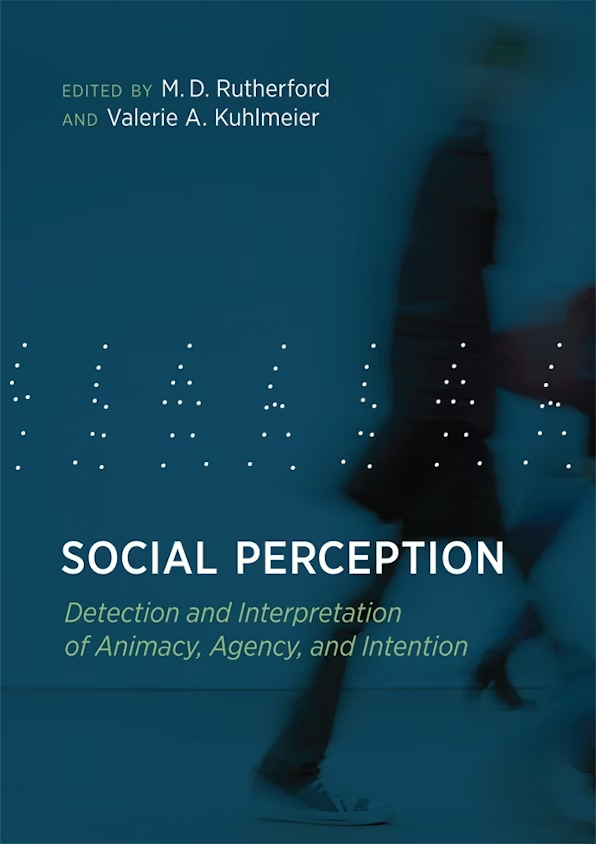
An interdisciplinary exploration of perceptual and cognitive processes underlying the ability to perceive social information, drawing on current research and new experimental techniques.
As we enter a room full of people, we instantly have a number of social perceptions. We have an automatic perception of others as subjective agents with their own points of view, thoughts, and goals, and we can quickly interpret minimal visual information to infer that something is animate. This book explores the perceptual and cognitive processes that allow humans to perceive and understand this social information quickly and apparently effortlessly. Top researchers in fields ranging from developmental psychology to vision science consider the perception of biological and animate motion, inferences based on this motion, and the early development of these abilities.
These innovative contributions reflect a recent renewal of interest in the attribution of agency and the understanding of goal-directed behavior, which has been accompanied by a rapid increase in empirical discoveries enabled by such new experimental techniques as brain imaging. The research presented in Social Perception suggests that an intuitive understanding of others is an integral part of human psychology, develops early, relies on a network of brain regions, and may be compromised in autism.

The first of its kind in Canada, Child Development: Perspectives in Developmental Psychology is a new topical introduction to child development, focusing on the psychological development of infants and children, with some treatment of adolescents. Written by Canadian professor M.D. Rutherford, the text covers all of the classic areas of developmental psychology, including a historical look at developmental psychology, important theories and methods (past and present), perceptual development, cognitive development, language development, moral development, and social development.
In addition, the text provides a comprehensive introduction that places a greater emphasis, although not an exclusive one, on evolutionary perspectives, drawing parallels and contrasts with an evolutionary perspective on developmental psychology, highlighting research that is consistent with what is known about evolution by natural selection.
Unique to this text is a critical discussion deconstructing the ‘nature versus nurture’ question in developmental psychology. Although the question is a classic question, dating back to the earliest writings about human development, our current thinking about development makes the ‘nature versus nurture’ question unanswerable: nature and nurture necessarily work together in development. As M.D. Rutherford states, ‘Without genes there is nothing that develops, and without the necessary environmental input, there is nothing that develops; every person and every trait of every person is a result of a genetic and environmental interaction’.

When Dr. Mel Rutherford became chair of his academic department, it was during a crisis—complex, emotional, and fast‑moving. What carried the department through was Values‑Based Governance and Shared Leadership.
In this talk, Mel brings audiences inside that experience.
Start with values. Then make them real. One of Mel’s first actions as chair was to bring the entire community together—faculty, staff, postdocs, graduate students, and undergraduates—to articulate their shared values. Those conversations became the foundation for a core values statement and, more importantly, a shared understanding of how the department wanted to work together.
From there, the group moved into action. They compared their core values statement with their actual procedures—hiring, mentoring, conflict resolution, decision‑making. This Gap Analysis revealed where their practices aligned with their values and where they didn’t. Once the gaps were visible, they could be closed.
Mel didn’t try to lead alone. He practiced shared leadership.
He launched a 10‑month strategic planning process that brought faculty, staff, and students into the conversation. Twelve roundtables. Dozens of voices. A strategic direction built together. People didn’t just have a seat at the table—they could see their vision in the outcome.
Shared leadership, as Mel teaches it, isn’t about delegating tasks. It’s about distributing influence, decision‑making, and ownership. It’s about creating a culture where leadership is practiced—not just by those with titles, but by anyone with insight and agency.
During his term, Mel sought wisdom from former chairs, involved over half the faculty in performance evaluations, and delegated leadership roles so he could stay responsive to emergent needs. Shared leadership wasn’t just modeled—it became a strategic priority.
The result? More trust. More transparency. More resilience.
Imagine bringing these strategies to your organization. When teams face uncertainty, upheaval, or emotionally charged moments, core values become a North Star. Values‑based governance isn’t abstract. It’s concrete and actionable. It’s a daily practice of listening, co‑creating, and choosing integrity over convenience.
And shared leadership isn’t about giving up control. It’s about inviting others to lead with you. When organizations do that, they become stronger, more inclusive, and far better prepared for whatever comes next.
This talk gives audiences a roadmap—practical, human, and immediately usable—for leading with clarity and courage in difficult times
Did you know that transgender leaders have superpowers, including perspective taking, empathy, and community building? Dr. Mel Rutherford has first‑hand experience navigating academic institutions as a pioneering transgender leader.
In this talk, Mel offers a candid, practical, and sometimes funny look at what it really takes to create an inclusive workspace for transgender employees and leaders. Drawing on lessons from his popular “Queer Etiquette” workshop, he uses humor as a gentle entry point into conversations that many organizations need but find difficult.
Mel weaves together research, lived experience, and leadership insight to illuminate how power, implicit bias, and organizational culture impact transgender people at work. He shares stories from his own leadership odyssey—stories about resilience, allyship, transformation, and the surprising clarity that comes from standing at the margins.
Participants leave with concrete strategies they can implement immediately: how to build psychological safety, how to query bias without derailing relationships, and how to support transgender colleagues in ways that are respectful, affirming, and aligned with organizational values.
This talk is ideal for leaders, HR professionals, and any organization ready to move beyond performative inclusion toward genuine cultural change. Mel’s invitation to lead with empathy, courage, and curiosity accessible and disarming.


(170 Words)
Dr. Mel Rutherford, PCC, is a professor of Psychology and a leading expert on how people perceive one another, and how such social perception develops. He graduated from Yale University and earned a Ph.D. in Psychology with an emphasis in Human Development from the University of California at Santa Barbara. A Fulbright Fellowship allowed Dr. Rutherford to study and collaborate with well-known Simon Baron-Cohen in Cambridge, England. Dr. Rutherford also worked with Bruce Pennington and Sally Rogers at the University of Denver as a postdoctoral fellow.
His book, The Glass Cliff: One Transman’s Leadership Odyssey, tells the story of stepping into crisis leadership and rebuilding a department through values‑based governance, shared decision-making, and compassionate accountability. Leaders navigating uncertainty and cultural change find his work especially resonant.
As a keynote speaker, executive coach, consultant, and workshop facilitator, Mel helps senior leaders and teams build clarity, trust, and courageous communication. He is known for his calm, candor, and ability to turn complex psychology into practical tools leaders can use immediately.
(85 Words)
Dr. Mel Rutherford, PCC, is a professor of Psychology, executive coach, keynote speaker, and author of The Glass Cliff: One Transman’s Leadership Odyssey. A Yale graduate, he earned his Ph.D. in Psychology from the University of California, Santa Barbara, and completed research through a Fulbright Fellowship in Cambridge, England. Mel helps leaders and teams strengthen communication, trust, accountability, and decision-making during times of growth and change. He is known for translating complex psychology into practical leadership strategies.
(43 Words)
Dr. Mel Rutherford, PCC, is a Psychology professor, executive coach, keynote speaker, and author of The Glass Cliff: One Transman’s Leadership Odyssey. He helps leaders build trust, communication, and accountability through practical, psychology-based leadership strategies for navigating change and uncertainty.
Get leadership insights, practical strategies, podcast updates, event announcements, and exclusive resources delivered straight to your inbox...

