

Build the practical leadership skills that help you delegate effectively, hold people accountable, and lead with confidence. This self-paced program combines real-world tools with coaching support to help you become the leader your team needs.

A guided learning experience for white leaders and teams who want to engage more effectively in conversations about race, equity, and inclusion. Participants gain practical frameworks for awareness, accountability, and action.

Get a clear roadmap for leading with greater clarity, confidence, and impact. Leadership Blueprint helps you identify your next leadership priorities and take focused action right away.
Melanie Parish, MCC, works with high performers in tech, empire builders, and unicorns. Is that you?


Melanie Parish, MCC, works with coaches who are committed to mastering their craft, expanding their awareness, and growing their confidence. Is that you?
Melanie Parish, MCC, works with teams that are ready to strengthen trust, improve collaboration, and achieve meaningful results together. Is that your team?


It’s time for management to start innovating, too. In this bold new approach to leadership, sought-after executive coach, speaker, and author Melanie Parish shows you how to approach projects and situations with a scientist’s mindset―testing hypotheses and analyzing results in a systematic way that will enable you to experiment and refine how you deal with challenges and opportunities.

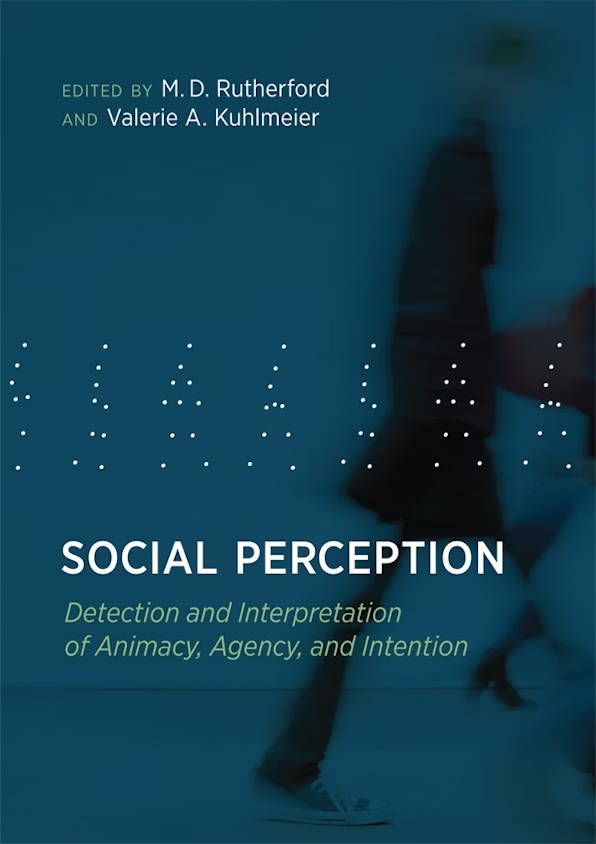
An interdisciplinary exploration of perceptual and cognitive processes underlying the ability to perceive social information, drawing on current research and new experimental techniques.
As we enter a room full of people, we instantly have a number of social perceptions. We have an automatic perception of others as subjective agents with their own points of view, thoughts, and goals, and we can quickly interpret minimal visual information to infer that something is animate. This book explores the perceptual and cognitive processes that allow humans to perceive and understand this social information quickly and apparently effortlessly. Top researchers in fields ranging from developmental psychology to vision science consider the perception of biological and animate motion, inferences based on this motion, and the early development of these abilities.
These innovative contributions reflect a recent renewal of interest in the attribution of agency and the understanding of goal-directed behavior, which has been accompanied by a rapid increase in empirical discoveries enabled by such new experimental techniques as brain imaging. The research presented in Social Perception suggests that an intuitive understanding of others is an integral part of human psychology, develops early, relies on a network of brain regions, and may be compromised in autism.

The first of its kind in Canada, Child Development: Perspectives in Developmental Psychology is a new topical introduction to child development, focusing on the psychological development of infants and children, with some treatment of adolescents. Written by Canadian professor M.D. Rutherford, the text covers all of the classic areas of developmental psychology, including a historical look at developmental psychology, important theories and methods (past and present), perceptual development, cognitive development, language development, moral development, and social development.
In addition, the text provides a comprehensive introduction that places a greater emphasis, although not an exclusive one, on evolutionary perspectives, drawing parallels and contrasts with an evolutionary perspective on developmental psychology, highlighting research that is consistent with what is known about evolution by natural selection.
Unique to this text is a critical discussion deconstructing the ‘nature versus nurture’ question in developmental psychology. Although the question is a classic question, dating back to the earliest writings about human development, our current thinking about development makes the ‘nature versus nurture’ question unanswerable: nature and nurture necessarily work together in development. As M.D. Rutherford states, ‘Without genes there is nothing that develops, and without the necessary environmental input, there is nothing that develops; every person and every trait of every person is a result of a genetic and environmental interaction’.
Get leadership insights, practical strategies, podcast updates, event announcements, and exclusive resources delivered straight to your inbox...
